|
StatusGo
Strategy in Motion
|
AI in Healthcare
|
|
|
“There’s no tipping point coming where things flip and the jobs are gone. The new reality is the opposite. The more we automate, the more expert human work there is to do.”
Dan Shipper, CEO of Every, on the paradox at the heart of AI: that automation expands rather than eliminates expert human work. Every, May 2026
|
|
Investment in Digital and AI
|
| 1 |
Standard Chartered to cut 7,000 jobs in AI push |
Standard Chartered will eliminate more than 7,000 corporate roles by 2030, roughly 15% of that workforce, as CEO Bill Winters replaces “lower-value human capital” with automation. Cuts concentrate in Chennai, Bangalore, Kuala Lumpur, and Warsaw. The move signals that AI-driven workforce restructuring has fully crossed into regulated, services-heavy industries, a pattern healthcare CFOs should expect next. Reuters
|
| 2 |
Anthropic and Gates Foundation launch $200M AI partnership |
Anthropic and the Gates Foundation committed $200 million over four years across grant funding, Claude credits, and engineering support, with global health and life sciences as the largest tranche. Initial work targets vaccine and therapy screening for polio, HPV, and preeclampsia, plus tools for health ministries on workforce, supply chain, and outbreak detection. For health system leaders, it signals where frontier-AI capacity for population health is heading. Anthropic
|
| 3 |
BLS data shows first AI-linked job losses, healthcare exempt |
New Bureau of Labor Statistics data show 18 AI-exposed occupations covering roughly 10 million jobs lost 0.2% headcount from May 2024 to May 2025, while overall employment grew 0.8%. Customer service reps fell 4.8%; credit authorizers are down 26.2% since pre-ChatGPT 2022. Medical secretaries are the lone exception, insulated by healthcare’s hiring boom for now. Bloomberg
|
| 4 |
Commure raises $70M at $7B valuation for healthcare AI agents |
Commure closed $70 million at a $7 billion post-money valuation led by General Catalyst, with Sequoia, Morgan Stanley, and Kirkland & Ellis joining. Total funding now sits at $750 million. The agentic AI platform targets the $1 trillion US administrative waste pile, with revenue cycle and clinical workflow tools deployed across 500-plus organizations and 3,000+ sites of care, including HCA and Tenet. Fierce Healthcare
|
| 5 |
Oura files confidential S-1 as ring revenue approaches $2B |
Oura confidentially filed a Form S-1 with the SEC, with Goldman Sachs, Morgan Stanley, and JPMorgan leading. The smart ring maker held an $11 billion valuation after October’s $900M Series E and projects ~$2 billion in 2026 revenue, double 2025. Paid memberships should top five million this quarter, with 80% first-year renewal. It is the first major public-market test of consumer health wearables. Business Wire
|
|
Payer Update
|
| 6 |
CVS finds 58% of seniors cite digital literacy gap |
CVS Health research shows 58% of Medicare-eligible respondents say low digital health literacy hurts their ability to manage care, while 86% are open to using digital tools. With boomers reaching one in five Americans by 2030, CVS is anchoring its $20 billion tech investment in Care Paths, self-service pharmacy, and Oak Street community classes. CVS Health
| Member Engagement |
Medicare |
|
| 7 |
UnitedHealth tracks daily AI queries by Optum workers |
UnitedHealth Group is monitoring whether some Optum employees run at least one daily query in tools like ChatGPT or Copilot, using an engagement dashboard to flag “adoption gaps.” The company says AI has helped avert 15 million-plus calls and adjudicate hundreds of millions of claims, backed by $1.5 billion in 2026 spend. AI usage is becoming a payer workforce KPI. Becker’s Hospital Review
|
| 8 |
Providence to wind down most insurance business in 2027 |
Providence Health Plan will exit the ACA market, stop renewing employer group contracts, and transfer Medicaid and Medicare Supplement programs after a $102 million net loss on $2.5 billion in 2025 revenue. The shutdown affects more than 260,000 commercial, 58,000 Medicaid, and 64,000 MA members. Providence joins Baylor Scott & White, Aetna, and Cigna in retreating as cost trend outruns reimbursement. KGW
|
|
StatusGo Intelligence
The Damage Map: 2025 Performance of the Top Blues
Operating losses across the BCBS federation, with investment income often masking the underlying underwriting collapse.
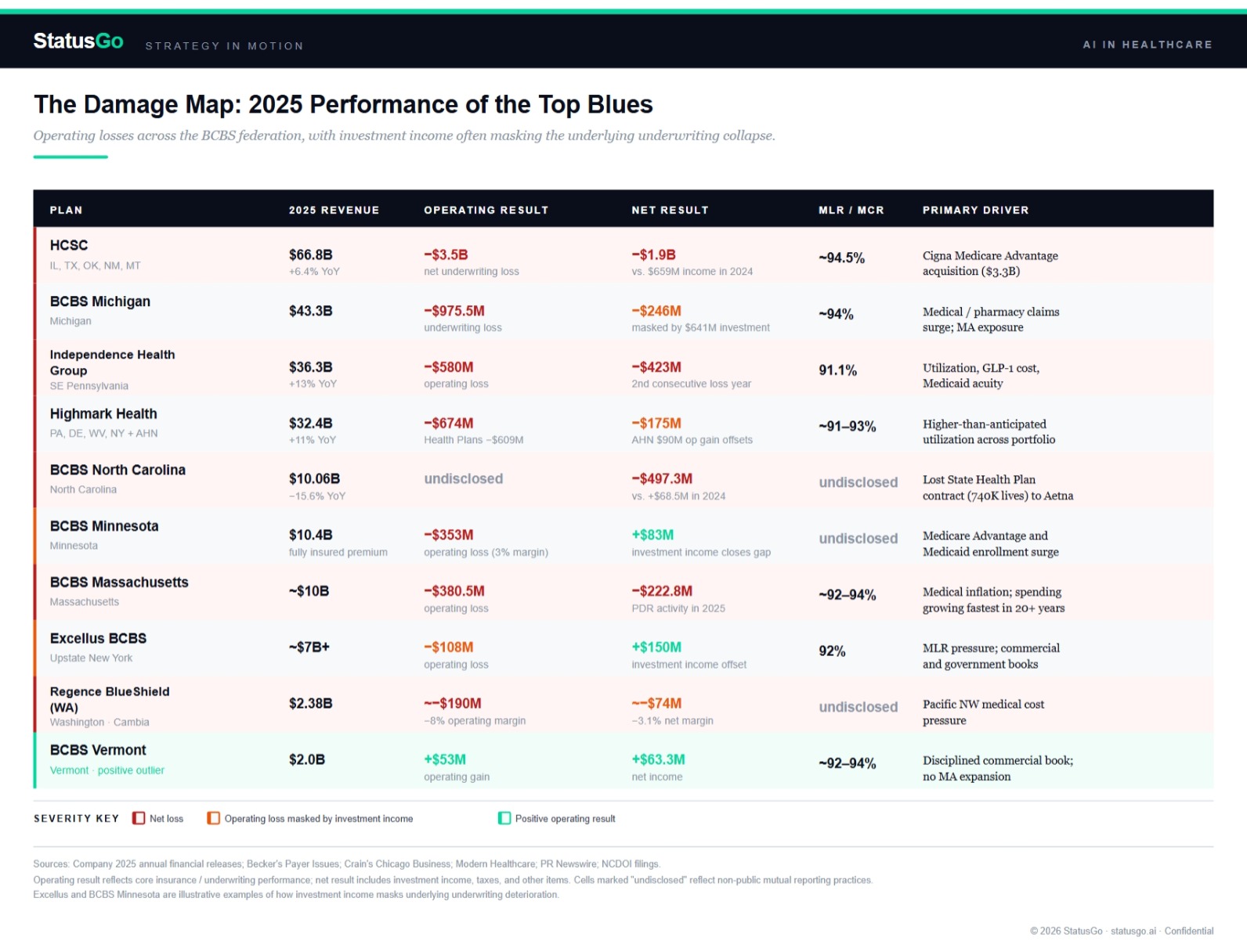
Sources: Company 2025 annual financial releases; Becker’s Payer Issues; Crain’s Chicago Business; Modern Healthcare; PR Newswire; NCDOI filings.
|
|
Provider Update
|
| 9 |
LLM discharge summaries boost patient activation in RCT |
A Lancet Digital Health RCT of 128 patients found GPT-4o-generated patient-oriented discharge summaries lifted PAM-13 activation scores by 9.6 points versus standard summaries, with 53% reaching the highest activation level versus 19% in controls. Activated patients carry roughly half the 30-day utilization risk, giving provider operators a credible, scalable lever on readmissions. The Lancet Digital Health
| Clinical AI |
Patient Experience |
|
| 10 |
Penn Medicine projects $105M AI ROI by fiscal 2028 |
Penn Medicine, the seven-hospital, $12 billion system, has formally budgeted $105 million in AI benefits by fiscal 2028, tied to radiation oncology contouring, ambient documentation, EHR search, and prior authorization. Project managers using AI copilots show up to 20% productivity gains. The “innovation with guardrails” framing gives other CIOs a concrete blueprint for moving governance from “no” to “yes.” Becker’s Hospital Review
|
| 11 |
Mayo Clinic AI trims ED length of stay by 12 minutes |
A Mayo Clinic prospective study in Nature Communications of 54,394 ED visits tested an AI admission-risk model, toggled on and off in two-week blocks over 11 months. The tool cut median ED length of stay by 12 minutes without raising 72-hour bouncebacks, holding AUC at 0.80 to 0.82. Hospitalists found it more useful than ED clinicians, a signal for targeted rollout. Nature Communications
|
| 12 |
Vanderbilt deploys first patient-facing AI in portal messaging |
Vanderbilt Health launched an AI assistant in its My Health at Vanderbilt portal that asks follow-up questions and drafts clearer messages to care teams. Built on OpenAI via a HIPAA-compliant Azure environment with retrieval-augmented VH triage protocols, the tool went live April 1 and will become the default messaging experience. It is VH’s first patient-facing AI at scale. Vanderbilt Health News
| Patient Experience |
Clinical AI |
|
|
How was this week’s newsletter?
|