|
||||||||||||||||||
|
“Of all the things humans have ever created, AI will change society the most. There is no upper limit on how intelligent AIs will get or on how good robots will get, and I believe the advances will not plateau before exceeding human levels.” Bill Gates, on why AI represents the most consequential technology shift of our era. GatesNotes, June 2026 |
||||||||||||||||||
| By the Numbers | ||||||||||||||||||
|
StatusGo Intelligence · National Health Spending Outlook 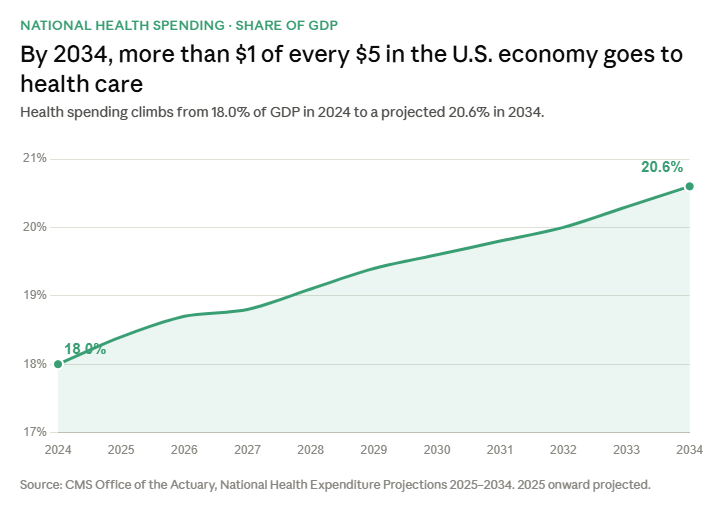
US health spending is projected to reach 20.6% of GDP by 2034, up from 18.0% in 2024, meaning more than $1 of every $5 in the economy goes to health care. In dollar terms that is a climb from $5.7T to nearly $9.0T. Source: CMS Office of the Actuary, National Health Expenditure Projections 2025-2034. |
||||||||||||||||||
| Provider Update | ||||||||||||||||||
Mayo Clinic joined ARPA-H’s PARADIGM program to bring AI-guided procedures to rural patients. Partnering with SRI International and the University of Florida, Mayo is building computer-vision tools that guide non-specialists through blood draws and IV placement in mobile units, identifying veins and needle placement. Year one logged 300 blood draws. Becker’s Hospital Review |
||||||||||||||||||
Healthcare AI vendor Xsolis disclosed a phishing breach exposing 1.4 million patients across seven health systems, including Mayo Clinic, UW Medicine and Legacy Health. A January intrusion, reported to HHS in June, exposed names, Social Security numbers and treatment data. Xsolis provides utilization management AI and reports no known misuse. Becker’s Hospital Review |
||||||||||||||||||
Indiana will cap what its five largest nonprofit hospital systems charge employer plans, requiring direct-to-employer contracts at or below 260% of Medicare starting September. By 2029, systems above a statewide average risk losing tax-exempt status plus $10,000 daily fines. The five control nearly half the market. Other states are watching. Becker’s Hospital Review |
||||||||||||||||||
Patient portal messages jumped 153% from 2020 to 2025, a JAMA study of Epic data across 2,000 hospitals found. Office visits rose 17% too, so messaging adds to care rather than replacing visits. The volume strains staffing and fuels burnout, positioning AI message drafting and triage as an efficiency play. Healthcare Dive |
||||||||||||||||||
| Payer Update | ||||||||||||||||||
HHS-OIG found ghost networks across the three largest Medicaid managed care payers. As many as 35% of in-network maternal health providers were missing from Centene’s directory, 25% for UnitedHealthcare, 11% for Elevance. Contact data was wrong up to 41% of the time. CMS concurred. These plans cover 29M enrollees. HHS Office of Inspector General |
||||||||||||||||||
A Holland & Knight review finds states, not Congress, leading AI healthcare regulation in 2026. At least six states including Alabama, Indiana and Washington now bar insurers from using AI as the sole basis to deny care, requiring human review. Separate laws restrict clinical AI, chatbots, and Utah’s prescription-renewal sandbox. Holland & Knight |
||||||||||||||||||
New HHS data released Friday shows 5 million fewer people are enrolled in ACA marketplace plans than last year’s record, leaving 19.2 million covered, down from 24.2 million. Roughly 1 million fewer chose plans and 4 million more dropped coverage or stopped paying after subsidies expired and premiums doubled. NPR |
||||||||||||||||||
| Investment in Digital and AI | ||||||||||||||||||
|
StatusGo Intelligence · The Collapsing Cost of AI Inference Inference costs are halving roughly every two months, a 9x to 900x annual decline depending on workload. Top-tier models now run at a fraction of historic prices, making enterprise-wide AI deployment financially viable at scale.
For payer and provider leaders, collapsing inference economics turn AI from a budgeted pilot into an operating default. Source: StatusGo analysis of published 2026 model pricing. |
||||||||||||||||||
UBS analyst A.J. Rice argues AI is becoming healthcare’s core operating layer, but hospitals, not insurers, gain the durable edge. Payer efficiencies in claims and prior authorization are too replicable to hold. For-profit systems like HCA and UHS already convert AI into revenue; UHS cited $50M annually via SmarterDx coding. Seeking Alpha |
||||||||||||||||||
Oracle cut roughly 21,000 jobs over 12 months, dropping to 141,000 employees, and named AI deployment as a driver in its annual filing. Severance hit $1.84B, up from $374M. For health system CIOs, the Oracle Health (Cerner) EHR backbone now sits inside a vendor aggressively trading headcount for AI. Bloomberg |
||||||||||||||||||
Connie Health raised a $40M Series B led by HealthQuest Capital, bringing total funding to roughly $85M. The AI-native platform pairs proprietary recommendation models with local Medicare brokers to match seniors to plans. The round coincided with its tenth acquisition, Clearlink’s Medicare book, as Connie expands into value-based care partnerships. The Wall Street Journal |
||||||||||||||||||
IMD professor Howard Yu applies Clayton Christensen’s disruption theory to AI: just as ARM chips unseated Intel, DeepSeek’s cheaper models threaten high-end incumbents like Nvidia. The lesson for leaders evaluating AI: low-end, efficient options often win from the fringes. DeepSeek’s V3 reportedly trained for $5.6M versus GPT-4’s $63M-plus. Howard Yu |
||||||||||||||||||
|
How was this week’s newsletter?
|
AI in Healthcare | What Comes Next Ep. 15
The cost of intelligence is falling fast, but the cost of healthcare is not creating a new operating reality where AI scale must contend with access gaps, regulatory complexity, cyber risk, and structural financial pressure.


Jun 29, 2026
•
3 min read