|
StatusGo
Strategy in Motion
|
AI in Healthcare
|
|
|
“I think we will be able to use these tools to cure a significant number of diseases that currently plague us. I think that will be one of the most viscerally felt benefits of AI.”
Sam Altman, CEO, OpenAI predicting AI will add 10 healthy years to human life expectancy and treat most diseases by 2035, speaking with Kara Swisher. CNN, May 2026
|
|
Provider Update
|
| 1 |
Abridge reaches $5.3B valuation as ambient AI becomes table stakes for health systems |
Abridge, the generative AI clinical documentation company founded by cardiologist Shiv Rao, closed a $300M round at a $5.3B valuation backed by Jensen Huang, Henry Kravis, USV, and Bessemer. After a five-year wilderness period, AI scribing has crossed a critical threshold: doctors now refuse to join health systems that don’t offer Abridge. The company has moved well beyond notes into orders, billing, and pre-charting, with 40% of model outputs generated by in-house models. For health system leaders, ambient AI is no longer a pilot program. It is a physician recruitment and retention tool. 20VC
|
| 2 |
Providence and Microsoft deploy AI to simulate clinical trials at scale |
Providence and Microsoft developed TRIALSCOPE, an AI framework that scours electronic health records to reproduce and simulate clinical trial results without requiring new patient enrollment. Trained on data from over 1 million cancer patients, the platform successfully reproduced lung and pancreatic cancer trial outcomes and simulated control arms, a step that typically requires years of patient exposure. The research was published in NEJM AI. For provider leaders, this reframes clinical trial infrastructure as a data and AI problem, with the potential to compress drug development timelines and reduce patient risk in the process. Chief Healthcare Executive
|
| 3 |
Microsoft: organizational culture drives 2x more AI value than individual effort |
Microsoft’s 2026 Work Trend Index, drawing on 20,000 workers across 10 countries, finds that organizational factors including culture, manager support, and talent practices account for more than twice the reported AI impact of individual effort. Only 19% of AI users operate in the “Frontier” zone where individual capability and organizational readiness reinforce each other, while 1 in 10 skilled workers are blocked by organizations that haven’t kept pace. Active agents in Microsoft 365 grew 15x year over year. For health system leaders, this reframes AI ROI as an organizational design problem, not a technology procurement decision. Microsoft WorkLab
|
| 4 |
Health system net income rebounded in 2025, but the gap between archetypes is widening |
Kaiser Permanente led all health systems with $9.3B in net income, followed by HCA Healthcare at $6.8B and Mayo Clinic at $5.2B. Of the 67 systems ranked, five posted net losses, including Providence ($238M), Presbyterian ($334M), and Montefiore ($56M). The top 10 systems collectively generated over $40B, while community and mission-driven systems face mounting structural pressure from labor costs and unfavorable payer mix. For health system CFOs, 2025 marked a recovery year, but the financial divergence between well-capitalized systems and margin-thin operators is accelerating. Becker’s Hospital Review
|
|
StatusGo Intelligence
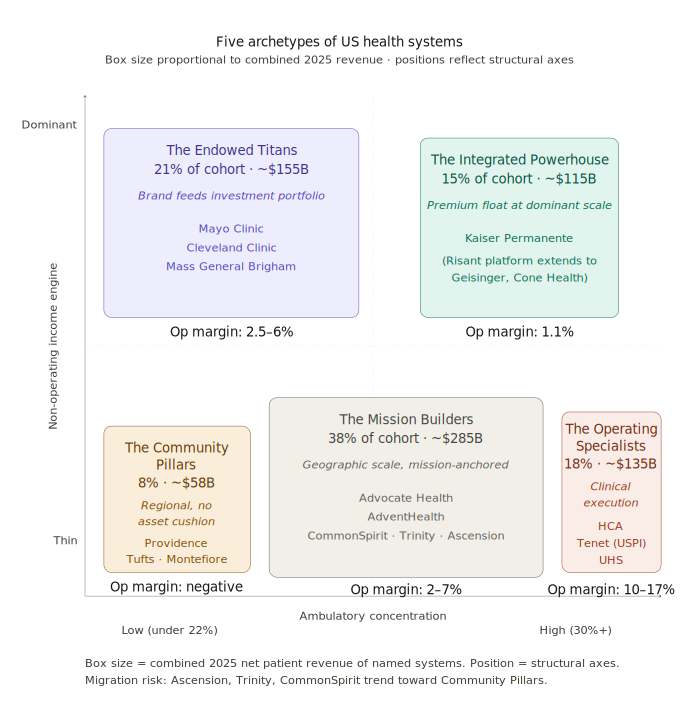
|
|
Payer Update
|
| 5 |
Major payers post combined $15.4B in Q1 profits as recovery takes hold |
The six largest U.S. payers reported a combined $15.4B in Q1 2026 profits, led by UnitedHealth Group at $6.3B on $86.3B in UnitedHealthcare revenue. CVS/Aetna posted $2.9B, Elevance $1.8B, Cigna $1.7B, Centene $1.5B, and Humana $1.2B. The results reflect conservative MA pricing, benefit reductions, and market exits beginning to flow through to margins. For payer and provider leaders, these numbers confirm the industry is stabilizing, but Q2 claims data will reveal whether the recovery is structural or seasonal. Becker’s Payer
|
| 6 |
UnitedHealth, CVS, and Elevance are becoming AI software companies |
The largest U.S. payers are converting internal AI investments into external revenue streams, blurring the line between insurer and vendor. UnitedHealth directs one-third of its $1.5B AI spend toward transforming Optum Insight into an AI-first software firm. CVS Health is launching Health100 with Google Cloud and Gemini AI as an enterprise healthcare engagement platform. Elevance reports its Health OS platform has reduced information-related denials by nearly 70%. For provider leaders, the same AI platforms payers use internally are now being sold externally, creating a structural conflict between payer tools and provider interests. Becker’s Payer
|
|
Digital and AI
|
| 7 |
OpenAI launches deployment company with $4B to embed AI into enterprise operations |
OpenAI launched the OpenAI Deployment Company, a standalone business unit backed by more than $4B in initial investment from 19 partners including TPG, McKinsey, Bain, Goldman Sachs, and SoftBank. The company acquires Tomoro, bringing 150 Forward Deployed Engineers from day one to embed inside organizations and redesign workflows around OpenAI models. Partners collectively sponsor more than 2,000 businesses worldwide. For health system CIOs and CFOs, this signals OpenAI moving from model provider to full-stack implementation partner, competing directly with traditional consulting firms on AI transformation engagements. OpenAI
| Technology |
Data & Infrastructure |
|
| 8 |
Anthropic overtakes OpenAI in business adoption for the first time |
Ramp’s May 2026 AI Index, tracking spend across 50,000 businesses, shows Anthropic surpassing OpenAI in paid adoption for the first time: Anthropic at 34.4% vs. OpenAI at 32.3%. Anthropic has quadrupled business adoption over the past year while OpenAI grew just 0.3%. Overall AI adoption crossed 50.6% of businesses. Ramp flags three headwinds for Anthropic: misaligned token-cost incentives, recent reliability issues, and model updates that tripled costs for image-heavy prompts. For health system CIOs selecting foundation model partners, vendor stability and cost trajectories now matter as much as capability. Ramp
| Technology |
Data & Infrastructure |
|
| 9 |
Microsoft: AI adoption hits 50% of businesses globally, U.S. ranks 21st |
Microsoft’s Global AI Diffusion Report shows AI usage rose from 16.3% to 17.8% of the world’s working-age population in Q1 2026, with 26 economies now exceeding 30% adoption. The U.S. ranks just 21st globally at 31.3%, while the UAE leads at 70.1%. The Global North-South gap is widening, with usage at 27.5% versus 15.4%. For health system leaders, AI adoption curves are steepening well ahead of most enterprise deployment timelines. Microsoft
|
| 10 |
ChatGPT enters personal finance, connecting 200M users to their bank accounts |
OpenAI launched personal finance tools in preview for ChatGPT Pro subscribers, integrating with Plaid to connect accounts across 12,000+ financial institutions including Chase, Fidelity, and Capital One. Users get a dashboard covering portfolio performance, spending, subscriptions, and upcoming payments. The product follows OpenAI’s April acquisition of personal finance startup Hiro and builds on the fact that 200 million users already ask financial questions on ChatGPT monthly. For payer and provider leaders, OpenAI is systematically becoming the consumer interface for health, finance, and benefits navigation simultaneously, compressing the space between AI assistant and care coordinator. TechCrunch
| Technology |
Digital Health |
|
|
How was this week’s newsletter?
|